3 Art and Disaster
Art is the memory of history. Disaster can undoubtedly serve as a catalyst for art in the depths of imaginations desperate to make sense of the presence of pain and waste and injustice in our universe. The products of their imaginations in turn light the way toward a more hopeful and resilient world.


Plague disposal in Fujiadian, Harbin 1910-1911
The Pesthouse of Jaffa Revisited
Acrylic on canvas composite; 50cmX60cm; 2024
A photo of the disposal of victims of plague in Harbin moved me greatly, especially given the eerie parallels to the pandemic of our own era. This piece offers perspective on today's fears by revealing how dangerous our world has always been. I created "The Pesthouse of Jaffa Revisited" as a kind of memento mori, a reminder that catastrophe is like an earthquake along the fault lines of history, creating havoc, but also fueling deeper geological changes in the culture. I was also inspired by “Napoleon in the Pesthouse of Jaffa” for its themes and desert setting.


Pandora's Box
Installation; wooden box, globe, mirror, clay, collage, etc.
50cmX60cmX50cm
2024
The history of humankind and its disasters begin with Pandora. Zeus gave her a sealed box full of catastrophes, plagues, and worries. It was finally opened, haunting our world ever since. I imagined Pandora’s Box in this installation. When the beautiful container was opened, it was filled with a mirrored globe, reflecting death, sin, and plague. Mankind has created great civilizations and unleashed untold disasters. If the box wasn't opened, what would the world have been like? “Had not the apple taken been, never would a lady be the queen of peace” says the Christian hymn in a spirit of unanimity with the Greek myth—were it not for the bedevilment of our world by a woman’s choice (Eve or Pandora), the possibility of honor in the face of injustice and redemption in the face of death (represented in the song by the Virgin Mary) would have been impossible. Pandora and Eve were not openers of a box of evil—perhaps they were the keys to human dignity, which cannot exist without challenges.
Mirror, Mirror on the Wall
Installation; mirror skeleton model rope clay, etc. 100cmX25cmX40cm
2024
A man was asleep, a skeleton dangling over his head, a shattered mirror reflecting his blurred world. Because of the history of the world's disasters, he seems lost in contemplation of the eternal. I was inspired here by Pompeiian mosaics, which often showed skeletons engaged in mundane activities, a darkly humorous, provocative, and ever thought-provoking genre.


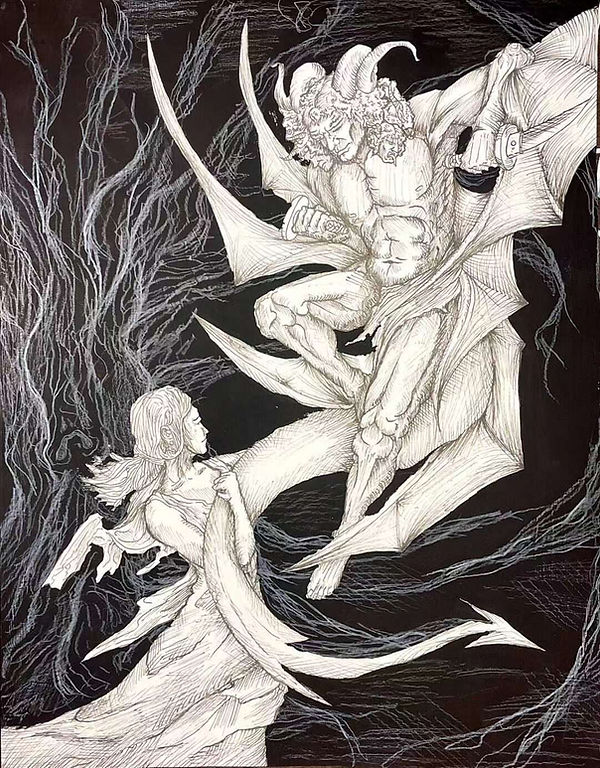
Draco et Proserpina
Pencil on paper; 35cmX25cm; 2021
This piece was the recipient of the American Classical League’s Creative Arts Competition’s Magna Cum Laude prize for drawing. In it, I explore several classical allusions to the advent of disaster. First, I depict Proserpina, the Roman iteration of the Greek Persephone, whose kidnapping sparked her mother Ceres’ descent into sorrow and the coming of winter to a weary world. She stands at the feet of a demonic figure reminiscent of Pluto, her captor and husband. However, the figure is not Pluto, but actually an embodiment of the red dragon from the Book of Revelation, the darkest book of the Bible which presages doom and destruction. At the same time, though, the inclusion of these figures also broadcasts hope: Proserpina was eventually liberated from hell, and the Book of Revelation also augurs the coming of a better age after Judgment Day.
Destiny

1

2
3
1: Medieval surgical images
2: Holbein
Ambassador, 1533
3: Huang Zhou
Sketches of the Yellow Plains, 1946


Installation; 55cmX38cmX25cm; 2024
Fortuna is the goddess of fortune and the personification of luck in Roman religion. Some artists depicted her as wearing a blindfold to represent 'blind luck,' a rare neutral or even positive depiction of blindness in popular culture (another is Justice, similarly blind). In this work, I created a pair of hands of Fortuna, which protrude from the wall to reveal fate to the audience. Would you dare to look, or are you better off in ignorance of what is to be?
Francis Bacon once said “Prosperity is not without many fears and distastes; adversity not without many comforts and hopes.” The disasters we see coming are not always possible to avoid, but perhaps their heat can make them the crucibles of stronger souls.