2 Faded Visions
There is an unfortunate reductionist tendency in certain strands of art historical criticism to overly simplify causation and artistic intention. Although Willem de Kooning and James Brooks were eventually diagnosed with Alzheimer's, ascribing causation to the disease as the major formative influence on their style is a tenuous conclusion. This is why the work of painter William Utermohlen was so interesting to me; he deliberately used his art to explore the progression of his battle with Alzheimer’s Disease.
In honor of my grandmother’s struggles with senility, I wanted to explore Alzheimer’s artistically. I analyzed it through empirical lenses as a scientist, but I hungered for holistic catharsis. Yet how could I create a piece that was true to my own experience, who was only a spectator and a helper and a researcher in the world of this disorder? I knew Utermohlen’s style was too sacred to be appropriated, so I sought ideas elsewhere.
When I discovered the work of Gerhard Richter, I knew I had found exactly the kind of inspiration I was after. His many works blurring out the faces of his subjects have nothing to do with dementia, yet the blank spaces where faces should be seemed reminiscent of the effects of Alzheimer’s. I employed his style when altering photographs of my family. Now the identities of family members young and old mysteriously blend, emphasizing not only the process of forgetfulness, but also the relationship between fate, inheritance, and continuity across the generations.


A Surreptitious Meeting with the Man Who Would Be My Father

This image’s classic triangular composition immediately caught my attention, along with the multigenerational theme, evocative old fashions, and distinctive headwear. By strategically blurring the features, it takes on a kind of timeless quality, since it is difficult to exactly date the piece. When you’re a child, you cringe when people say you’ll grow up to be like your parents some day. But the older you get, the more comfortable you become in emulating the best in them and forgiving them for the worst in them. When I look at this piece divorced from the original expressions of the subjects, I wonder what their emotional relationships were to each other, and how much the tone might change if they were, for example, all frowning. I imagine different expressions on their faces and all the stories that their juxtaposition might tell.

Digital painting; 2023
Speed


Digital painting; 2023

Through the eyes of the old
This high-speed world is too new
It's rocking and jolting
One day we will no longer be young
Then we too will understand
It's not that the old are too slow
It's that we are too fast
This is an image of my mother, who was a student in Switzerland at the time. With her features blurred away, it could almost be me. I know how I would feel if I were in her shoes in those heady days: awed by the natural beauty all around me, thrilled by the promise of the future, a little bit afraid, a little bit homesick... But reading ourselves into the experiences of our ancestors might be foolhardy. In the original photo, her face seemed so earnest, so eager. By removing her expression, I tried to make the piece a kind of elegy for the innocence of former youth.

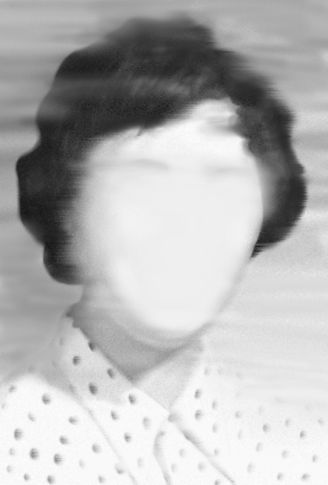

Untitled (*Blank Face of my Grandmother)
Digital painting; 2023
I never met my grandmother. She died at the age of 39. In materialist terms, death is the irreversible loss of consciousness. As far as idealism is concerned, death is only a starting point to another world. In terms of society, death is a mechanism of social fairness: everyone will die, leaving room for others to live. In terms of life, death is the law of nature and the natural destination of everyone.
Three Generations

We form an inextricable web with our ancestors and descendants, a kind of multigenerational waterfall where genes flow down the generations and trickle again and again into the originality of new souls. Like genes, memories are also passed down through the generations, connecting us to cultural families even more all-encompassing than our personal genetic heritages. When I think of my grandparents’ generation, I am reminded not only of the hardships of 20th century Chinese history, but also of a more quiet and less relentlessly interconnected world which I would love to visit. As genes cascade through the generations, it is as if, bewitched by technology, time itself is speeding up and getting louder. Sometimes I long for the slow, the quiet, and the magnificently boring.

Digital painting; 2023
Proximity or Distance?

The scene of a girl and her brother at the piano looks like something out of Norman Rockwell, but imagine the possibilities. What if my brother is enraged that his practicing is being interrupted by me? What if he is overjoyed to be sharing this moment? What if he is trying to concentrate while I am selfishly making a racket? What if I am laughing? What if I am crying? Our emotions shape our memories as much as the objective facts of what we once did. If you displace the image from its emotional framework, we are left with less certainty, but also the possibility of endless interpretation and rediscovery.
I only discovered a few years ago that my brother was adopted, and I wonder how our dynamic might have changed if I knew this at the time when we were children. I’d like to think we’d be just as much in harmony, but the empty expressions here also threaten alternate timelines.

Digital painting; 2023